After more than two decades of building technology for schools, universities and workplaces around the world, Webanywhere is starting another chapter – with a new home in Ilkley, West Yorkshire.
We’ve moved into new offices at IDC Ilkley, Valley Road, Ilkley, LS29 8AL.
For me, this is more than simply changing our address. It represents where I believe Webanywhere needs to go next.
Bringing people back together
Like many technology businesses, the way we work changed considerably after the pandemic. Remote working gave us flexibility and proved that talented teams could deliver great work from almost anywhere.
But something else became increasingly clear.
Technology makes it incredibly easy to communicate. It doesn’t necessarily make it easy to collaborate.
Some of the best ideas at Webanywhere over the last 23 years haven’t emerged from scheduled video calls. They’ve come from conversations between colleagues, somebody looking over another person’s shoulder, a customer problem being discussed across a desk, or a spontaneous idea that turns into a product.
That’s difficult to recreate entirely online.
Our new Ilkley office therefore becomes the centre of our hybrid working model, with our team coming together in person, while retaining the flexibility of working remotely.
Why Ilkley?
Ilkley feels like a natural home for Webanywhere.
We’re a Yorkshire business with increasingly international ambitions. Today we work with customers and colleagues across the UK, United States and Poland, but Yorkshire remains an important part of our identity.
IDC gives us a modern base within walking distance of Ilkley railway station, surrounded by one of the best towns in Yorkshire.
It also gives us something particularly important: somewhere customers, partners and friends of Webanywhere can visit us.
Building the next Webanywhere
The timing matters too.
Artificial intelligence is creating perhaps the biggest change I’ve witnessed since starting Webanywhere in 2003.
Education is changing. Workplace learning is changing. Software development is changing. And the expectations people have of technology are changing extraordinarily quickly.
We’re investing heavily in that future.
Alongside School Jotter, which continues to help schools improve their websites and digital communications, we’re developing Learner Journey, our new platform bringing together learning, AI, events, communities, bookings, jobs and professional development.
We want the Ilkley office to become somewhere those ideas can develop.
A place where developers sit alongside salespeople.
Where customers can come for workshops.
Where educators can explore AI.
Where we can demonstrate new products.
And, most importantly, where people can learn from each other.
An office should earn its existence
I’ve never believed that people should commute simply to sit at a desk wearing headphones and conduct the same Teams meetings they could have done from home.
If we’re asking people to come together, there needs to be a reason.
The purpose of the office isn’t attendance.
It’s collaboration, creativity and learning.
That’s why we’ll be using IDC for team sessions, product development, customer workshops, CPD, AI training and events – not simply as somewhere to put laptops.
Back to our roots, looking forward
There’s something fitting about making this move now.
Webanywhere started in Yorkshire in 2003 with a fairly simple idea: that the internet could transform the way people learn.
Twenty-three years later, the technology has changed beyond recognition.
That underlying belief hasn’t.
If anything, with AI, it feels more relevant than ever.
So our new office isn’t really about bricks, desks or meeting rooms.
It’s about creating a place where the next chapter of Webanywhere can be built.
If you’re a customer, partner, school, college, university, employer – or simply interested in what we’re building – we’d love you to come and visit us in Ilkley.
Professional development events can be surprisingly complicated to organise.
A relatively simple training day might require an organisation to advertise the event, take bookings, process payments, send joining instructions, manage cancellations, record attendance and issue certificates. Once the event is over, organisers may also need to distribute presentations, provide follow-up learning and keep a record of who attended.
In many organisations, these jobs are spread across several different systems. An events platform might handle bookings, a payment provider collects the money, spreadsheets hold attendance records, emails contain joining instructions and certificates are created and distributed separately.
Learner Journey is attempting to bring these activities together by treating an event as part of a wider learning process rather than as a standalone booking.
From booking an event to managing CPD
The distinction is particularly important for organisations delivering continuing professional development.
A concert organiser, for example, primarily needs to sell tickets and get people through the door. For a professional development provider, attendance is only one part of the process.
The organisation may need to know whether somebody completed some preparation beforehand, whether they attended the event, what they learned and whether they completed any follow-up activities. It may also need to provide evidence of completion.
This is the thinking behind the Learner Journey Events module.
An organisation can create an event, publish it online, take registrations and manage attendees. Events can be free or paid, with payments handled through Stripe. Organisers can set capacity limits, use promotional codes and collect additional information from people when they register.
The system can also accommodate events intended for different groups. An organisation could, for example, restrict an internal training session to employees using approved email domains, while making another event available to the general public.
This could be useful for a multi-academy trust that provides free professional development to its own staff while charging external schools to attend the same programme.
Payments are only part of the process
Taking payment for an event is relatively straightforward. Managing everything that happens around that payment is often more difficult.
A professional development provider might run dozens or even hundreds of events during a year. Some may be free, while others could cost £50, £200 or considerably more. There may be different prices, promotional offers or arrangements for particular groups.
Learner Journey connects the booking and payment process to the event itself. Organisers can see registrations and attendee information without having to reconcile several separate systems.
Capacity can also be managed through the platform. When an event is full, people should no longer be encouraged to buy a ticket for a place that does not exist.
These may sound like relatively small administrative details, but they become significant when an organisation is managing a large programme of events.
What happens when somebody cancels?
Events rarely run exactly as planned.
People cancel, dates change and attendees sometimes need to reschedule. An event might reach capacity more quickly than expected or an organiser may need to make changes after bookings have already been taken.
The Learner Journey Events module is designed to manage cancellations and rescheduling alongside the original booking.
The aim is to reduce the amount of manual administration that takes place through email. Instead of the event organiser becoming the person who has to connect the booking system, payment records, attendee spreadsheet and email correspondence, more of the process can be managed in one place.
For a small event, the saving might only amount to a few minutes. Across hundreds of events and thousands of attendees, it can become substantial.
Certificates become part of the learner’s record
Certificates are another example of a simple task that can become surprisingly time-consuming.
Many CPD providers still create certificates after an event and distribute them individually or through bulk email. Months later, attendees may contact the organisation because they have lost their certificate and need another copy.
Learner Journey allows organisations to associate branded certificates with events.
Once attendance and completion have been confirmed, a certificate can be issued to the participant. Where the attendee has a Learner Journey account, the certificate can form part of their continuing record of learning. Certificates can also be distributed electronically to other attendees.
The important change is that the certificate is no longer treated simply as an attachment to an email. It becomes evidence of an activity that sits alongside the event and the learner’s wider professional development.
What happens before the event matters too
There is also an opportunity to rethink what happens before somebody arrives at a training session.
Imagine a teacher attending a course on improving classroom oracy. A week before the event, they could be given access to a short video, some background reading and a simple self-assessment.
They might be asked to rate their confidence in leading structured classroom discussions before attending the course.
The trainer then starts the event with participants who have already thought about the subject. The organisation also has a baseline against which later progress could potentially be compared.
Because Learner Journey includes pages, quizzes, assessments, videos, podcasts, files and learning paths as well as events, these activities can sit alongside the booking.
The process therefore changes from simply registering and attending an event to completing a more structured learning journey.
Learning can continue after people go home
The period after an event may be even more important.
Traditional event management tends to end when the event finishes. Professional development should not necessarily work in the same way.
After attending a course, a participant could return to Learner Journey to access the presentation, watch a recording, download supporting resources or complete an assessment.
They might be asked a week later to describe one change they have made as a result of the training. A further assessment several weeks later could help the organisation understand whether participants feel more confident or have put the learning into practice.
This creates an important distinction between measuring attendance and measuring impact.
An organisation might be able to say that 400 teachers attended its training programme. That is useful information. Being able to demonstrate what those teachers learned, what they subsequently did and whether their confidence or knowledge changed is considerably more valuable.
AI could extend the life of a training event
Learner Journey also includes an AI Tutor that can work with content approved by an organisation.
This creates another possibility for professional development providers.
A trainer might deliver a two-hour session and provide presentations, guidance documents and other resources. Those materials can continue to support participants after the event has finished.
If a participant has a question several weeks later, the AI Tutor can help them find answers based on the organisation’s approved learning material.
This does not replace the trainer. Instead, it makes the trainer’s knowledge and resources easier to access after the original session has ended.
For organisations running large professional development programmes, this could help extend the useful life of the material they are already producing.
From individual events to professional communities
There is another potential benefit.
Professional events frequently bring together people who have very similar interests and problems, but the community often disappears when the event finishes.
A Teaching School Hub might bring together 50 science teachers for a subject network meeting. A professional association might bring together hundreds of members for a conference. A multi-academy trust might gather its headteachers for a leadership programme.
The people attending these events are potentially valuable to one another as well as to the organisation delivering the event.
By combining events with learning content and community features, Learner Journey can provide somewhere for that relationship to continue.
A subject network, for example, could hold face-to-face meetings throughout the year while using Learner Journey between meetings for resources, discussions and additional learning.
The event becomes one element of an ongoing professional community.
A different model for Teaching School Hubs and academy trusts
This approach could be particularly relevant to organisations such as Teaching School Hubs and multi-academy trusts.
A Teaching School Hub might run dozens of programmes, workshops, conferences and network meetings during an academic year. It needs to promote those opportunities, manage registrations, communicate with participants and record attendance.
It may also need to demonstrate the reach and impact of its professional development.
A multi-academy trust has a slightly different challenge. It may need to organise internal CPD for thousands of employees across several schools while also providing programmes that are available to external participants.
Learner Journey could allow these organisations to manage internal and external events through the same platform, while controlling who can register and whether they need to pay.
Certificates, learning materials and follow-up activities can then be connected to those events.
The bigger opportunity is reducing administration
Much of this is not particularly glamorous technology.
Automatically closing registration when an event is full will not transform professional development. Neither will generating a certificate or allowing somebody to cancel a booking.
The benefit comes from putting these small activities together.
If an administrator no longer has to maintain several spreadsheets, manually reconcile bookings, repeatedly answer cancellation emails, create certificates and send resources separately after each event, a significant amount of time can be saved.
More importantly, the organisation can spend more time thinking about the quality of its professional development rather than the administration required to deliver it.
The event is only one part of the journey
This is ultimately the idea behind Learner Journey Events.
Traditional event software tends to concentrate on getting somebody from discovering an event to attending it. For many events, that is exactly what is required.
Professional development is different.
There is an opportunity to connect what happens before an event, what happens on the day and what happens afterwards.
A participant might discover a course, register, make a payment, complete some preparation, attend the event, access follow-up resources, complete an assessment and receive a branded certificate.
They might then join another event or continue participating in a professional community.
For the organisation, all of those activities form part of the same relationship with the learner.
That is why the most interesting part of LearnerJourney’s Events module may not be the events themselves.
It is the ability to turn a single event into part of a much longer learning journey.
The organisations that succeed in the age of AI won’t be those with the most technology – they’ll be the ones that help their people use it best.
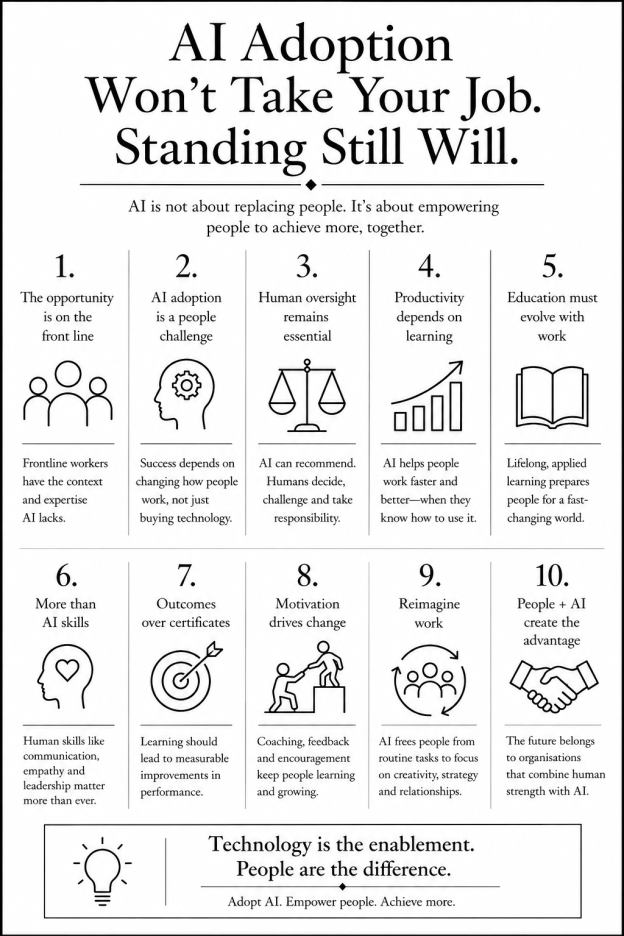
For much of the past decade, the conversation around artificial intelligence has been dominated by fear. Headlines have focused on automation, job losses and machines replacing people. Yet this narrative misses the most important opportunity AI presents. The future is not about replacing human capability; it is about amplifying it.
Artificial intelligence is rapidly becoming one of the most powerful tools ever created, but on its own it delivers very little value. Real transformation happens when AI is placed in the hands of people who understand their work, their customers and their organisations. Technology provides speed, scale and analysis. People provide judgement, experience, empathy and accountability. The competitive advantage lies in combining the strengths of both.
The real opportunity is on the front line
The people best placed to unlock AI’s potential are rarely those sitting furthest from the work. They are the teachers who understand how individual pupils learn, the customer service adviser who knows why complaints escalate, the engineer who recognises subtle problems before sensors detect them, and the healthcare professional whose experience tells them something isn’t quite right.
These frontline workers possess something AI does not: domain expertise and context. They understand the nuances, exceptions and human factors that cannot simply be inferred from data. When these individuals learn to work effectively alongside AI, they become dramatically more productive, more creative and better equipped to solve complex problems.
This is where the greatest opportunity for organisations exists—not simply deploying AI systems, but enabling every employee to use them confidently and responsibly to improve the quality and efficiency of their work.
AI adoption is a people challenge, not a technology challenge
Many organisations still approach AI as though it were another IT project. They purchase software, launch pilots and expect transformation to follow automatically. It rarely does.
Successful AI adoption depends on people changing how they work. Employees need practical experience, confidence and opportunities to experiment safely. They need to understand not just what AI can do, but when to trust it, when to question it and when human judgement must take precedence.
This requires a different approach to learning. Generic awareness sessions and one-off training courses are not enough. People learn best when education is directly connected to the challenges they face every day. AI skills become meaningful only when they help someone write a better proposal, analyse information more effectively, improve customer service or make better decisions.
The goal is not simply to teach people about AI. The goal is to help them become better at their jobs.
Human oversight remains essential
As AI becomes increasingly capable, human responsibility becomes even more important. Organisations must ensure that people remain accountable for decisions, outcomes and ethical standards.
AI can generate recommendations, draft documents and identify patterns at extraordinary speed, but it cannot replace human judgement. It cannot fully understand organisational culture, ethical considerations or the subtle context surrounding many important decisions.
This is why concepts such as human agency and AI oversight are becoming central to responsible AI adoption. Employees must feel empowered to challenge AI outputs, recognise potential errors and apply professional judgement before acting.
The most successful organisations will not remove humans from decision-making—they will equip humans to make better decisions with AI.
Productivity depends on learning
For more than a decade, UK productivity growth has remained stubbornly weak. While organisations continue investing in technology, many have overlooked the single biggest driver of productivity improvement: helping people work differently.
AI offers an opportunity to rethink how work is performed. Routine tasks can be completed faster, information can be analysed more effectively and repetitive administrative work can be significantly reduced. This creates more time for creativity, collaboration, innovation and meaningful customer interaction.
However, these benefits only materialise when people know how to integrate AI into their daily workflows. Technology alone does not improve productivity. Capability does.
Education must evolve alongside work
The implications extend far beyond the workplace. Education itself must evolve if society is to prepare people for an AI-enabled economy.
The UK Government’s increasing focus on technical education, apprenticeships, lifelong learning and workplace skills reflects a growing recognition that careers are changing. Few people entering work today will spend their careers doing exactly the same role. New technologies will continue to reshape industries, requiring people to learn continuously throughout their lives.
Education must therefore become more closely connected to real-world application. Learners need opportunities to solve authentic problems, apply knowledge in practical settings and develop confidence using emerging technologies responsibly.
Equally important is ensuring that educators themselves play a central role in shaping this future. Teachers understand how people learn, how confidence develops and how motivation is sustained. Their insight is invaluable as education adapts to meet the demands of a new industrial era.
The future requires more than AI skills
Technical capability alone will never be enough.
As artificial intelligence becomes more powerful, the uniquely human skills become increasingly valuable. Communication, emotional intelligence, leadership, creativity, collaboration and resilience will distinguish outstanding employees from average ones.
Young people entering the workforce will need to navigate difficult conversations, build relationships, influence others and demonstrate empathy—skills that no AI system can genuinely replicate.
The future belongs to individuals who combine technological confidence with deeply human capabilities.
Learning must drive measurable outcomes
For too long, organisations have measured learning by attendance, course completion and certificates achieved. These metrics reveal very little about whether learning has improved performance.
The future of workplace learning is outcome-driven. Training should lead to measurable improvements in productivity, customer satisfaction, quality, compliance, innovation and business performance.
Employees also need ongoing encouragement. Learning is not a single event but a continuous process. Intelligent coaching, timely feedback and personalised recommendations can help people maintain momentum, build confidence and apply new knowledge in meaningful ways.
Ultimately, organisations should not invest in learning simply to increase knowledge. They should invest in learning that changes behaviour and delivers better results.
Reimagining work for the AI age
Artificial intelligence represents one of the greatest opportunities for economic growth and human advancement in generations. But its success will depend far less on algorithms than on people.
The organisations that thrive will be those that empower their employees to combine human expertise with artificial intelligence. They will encourage experimentation while maintaining oversight. They will invest in lifelong learning rather than one-off training. Most importantly, they will recognise that technology is at its most powerful when it enhances human capability rather than replacing it.
The future of AI adoption is not about choosing between humans and machines. It is about enabling people to achieve more than they ever could alone.
Discover how Learner Journey helps organisations build AI capability, measure AI adoption and deliver real workplace outcomes through applied learning:https://learnerjourney.com
In 1900, the world’s most valuable companies owned railways, steel mills, and oil fields.
A century later, the most valuable companies owned software.
Today, something even more unusual is happening.
The companies most likely to dominate the next century may not be those with the biggest factories, the largest workforces, or even the most sophisticated artificial intelligence. They may simply be the organisations that learn faster than everyone else.
Recently, Microsoft CEO Satya Nadella described what he believes is the defining challenge of the AI era.
He wrote:
“You can offload a task, or even a job, but you can never offload your learning.”
That sentence may turn out to be one of the most important observations about artificial intelligence.
For years, organisations have focused on productivity. How do we automate tasks? How do we reduce effort? How do we do more with less?
AI appears to offer an answer to all of those questions.
But Nadella argues that the real issue is not automation.
It is learning.
Every organisation possesses something invisible.
A school has it.
A university has it.
A hospital has it.
A business has it.
It lives in conversations, meetings, documents, voice notes, presentations, emails, and the accumulated experience of thousands of people.
Most of this knowledge never appears in a database.
It sits quietly inside human beings.
And when those people leave, retire, move on, or simply forget, much of that knowledge disappears with them.
This is where the next generation of learning platforms becomes interesting.
Traditionally, learning management systems were little more than filing cabinets for courses. They stored content and tracked completion.
Useful.
But hardly transformative.
The AI era demands something different.
It requires a system capable of capturing expertise, transforming it into knowledge, distributing it across an organisation, and continuously improving that knowledge over time.
At first glance, Learner Journey looks like a modern learning platform.
Users can create learning paths, publish content, generate quizzes, build assessments, issue certificates, create podcasts, videos, and learning experiences.
But underneath those features lies a more significant concept.
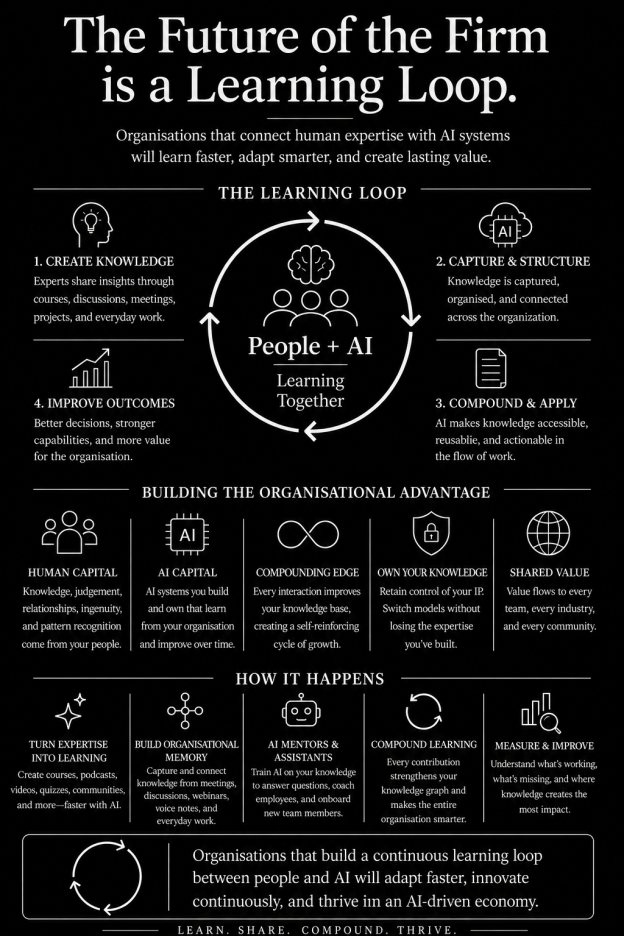
Learner Journey is designed to help organisations build what Nadella calls a learning loop.
Imagine an experienced teacher explaining how they support children with dyslexia.
Or a sales manager describing how they handle difficult negotiations.
Or a healthcare professional sharing years of practical experience.
With Learner Journey, that expertise can be captured as a voice note, a document, a video, or a simple prompt.
Artificial intelligence can then transform it into structured learning experiences complete with multimedia content, assessments, AI tutors, podcasts, summaries, transcripts, and personalised learning journeys.
The expertise no longer belongs to one individual.
It becomes part of the organisation.
The next employee learns from it.
The next team builds on it.
The next generation improves it.
And over time, something remarkable happens.
The organisation becomes smarter.
Not because AI replaced people.
But because AI amplified people.
This distinction matters.
Much of the public conversation around AI assumes a competition between humans and machines.
Nadella suggests the opposite.
He describes a future built on two forms of capital.
Human capital.
And token capital.
Human capital is judgment, creativity, relationships, expertise, and experience.
Token capital is the AI capability an organisation develops and owns.
The organisations that succeed will not maximise one at the expense of the other.
They will create systems where both grow together.
That is precisely what platforms like Learner Journey enable.
Every learning path created.
Every question answered.
Every insight shared.
Every expert contribution.
Adds another layer to the organisation’s collective intelligence.
The result is not merely a course library.
It is institutional memory.
It is organisational knowledge.
It is competitive advantage.
The most valuable asset in the AI era may not be a model.
Models will improve. Models will change. Models will be replaced.
The valuable asset is the learning loop that sits on top of those models.
The knowledge unique to your organisation.
The expertise your people have accumulated.
The judgment developed through years of experience.
The patterns that only your organisation can see.
As Nadella argues, companies must retain sovereignty over this knowledge rather than surrendering it to a handful of large AI systems.
The organisations that capture, structure, and compound their learning will possess an advantage that is extraordinarily difficult to copy.
Which raises an intriguing possibility.
Perhaps the future belongs not to the companies with the most AI.
But to the companies that learn most effectively alongside it.
If that proves true, then learning platforms will no longer sit at the edge of the organisation.
They will sit at the centre.
Because in the age of AI, learning is no longer a support function.
It didn’t start with a product idea. It started with a belief.
A simple one: learning never ends.
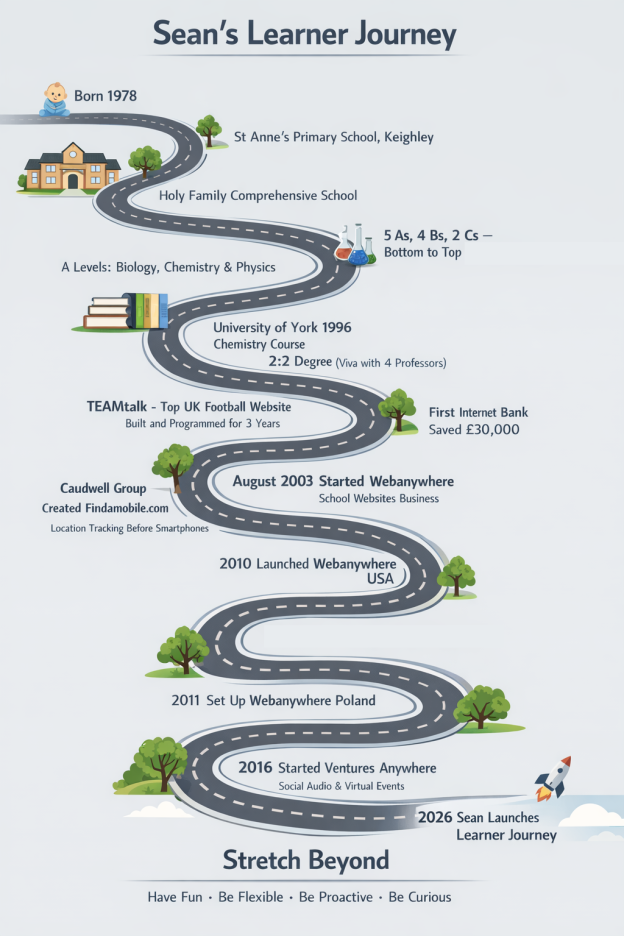
Years ago, I found myself doing what many of us do without really thinking about it—I was teaching myself. Late nights, searching the internet, watching videos, reading articles, testing ideas, failing, trying again. No classroom. No teacher. Just curiosity and persistence.
That was my learning journey.
And somewhere along the way, I realised something important: the most powerful learning I had ever done wasn’t structured, packaged, or handed to me. It was something I created for myself.
That idea stuck.
A Domain Name… and a Bigger Idea
At the time, I owned the domain learnerjourney.com. It felt significant. Not because of the name itself, but because of what it represented.
Learning isn’t a course.
It isn’t a module.
It isn’t something you “complete.”
It’s a journey.
And yet, most systems treat it like a checklist—start here, finish there, tick the box.
I wanted to build something that reflected reality. Something that recognised that learning is continuous, personal, and evolving.
From Consumer to Creator
The real turning point came when I asked a simple question:
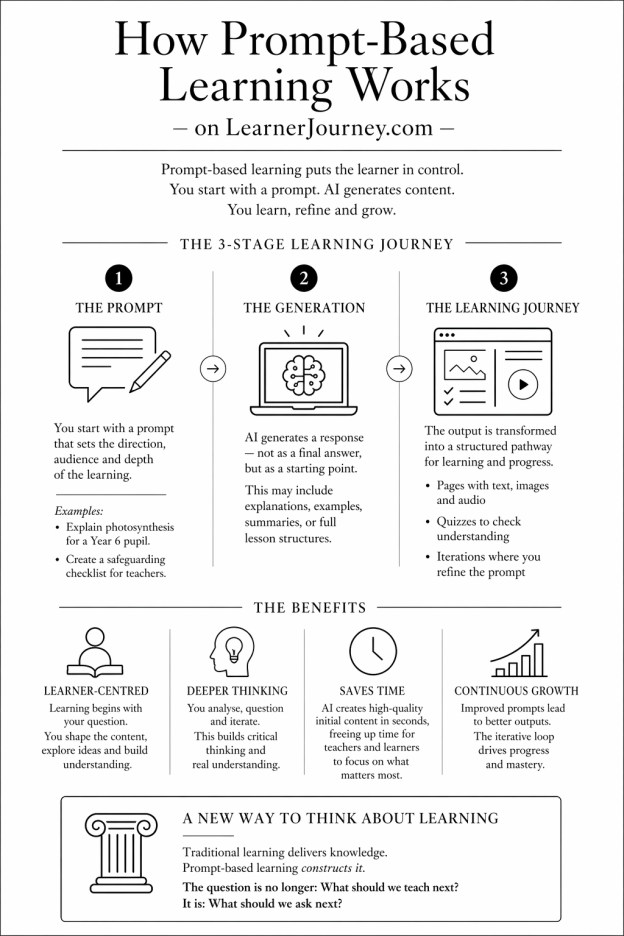
What if learners didn’t just consume content… but created it?
Instead of teachers doing all the work, what if students could build their own learning paths?
A learning path isn’t complicated. It’s just a series of pages—text, images, videos, podcasts, quizzes—woven together around a topic. But when a learner creates it themselves, something changes.
They engage differently.
They think differently.
They own it.
A student revising for exams can build their own path.
Someone learning Spanish can mix podcasts, quizzes, and notes.
A professional can map out skills they want to develop.
Learning becomes active. Creative. Personal.
And most importantly – memorable.
The Power of Sharing the Journey
But learning, for me, was never just about the individual.
It was about connection.
So we built Learner Journey to be social.
Not in the noisy, distracting way most platforms are – but in a meaningful way.
You can share your learning path.
Others can follow it.
They can complete it.
You can see their progress.
You can message them, collaborate, improve.
It becomes a shared experience.
And at the end of that journey, there’s a certificate. Not just as a piece of paper, but as a signal – like a badge you earn in Scouts.
A micro-credential.
A proof of effort.
Something you can show the world and say, “I learned this.”
A Learning Passport for Life
One of the biggest frustrations I’ve always had with education is how fragmented it is.
You move from school to college.
From college to university.
From university to work.
And every time – you start again.
Your learning doesn’t travel with you.
I wanted to change that.
Learner Journey is designed to stay with you. A kind of lifelong learning passport.
Something you build over time.
Something you carry with you.
Something that grows as you grow.
Not owned by an institution—but by you.
The Bigger Vision
If there’s one thing I hope Learner Journey changes, it’s this:
That we stop seeing learners as consumers… and start seeing them as creators.
Yes, you can learn from other people’s journeys.
But the real magic happens when you build your own.
Because when you create your learning, you don’t just understand it.
You internalise it.
You personalise it.
You remember it.
And maybe most importantly—you enjoy it.
In the End, It’s Personal
Learner Journey is, in many ways, a reflection of how I learned.
Unstructured. Curious. Creative. Social.
It’s the platform I wish I had.
And if it works the way I hope it will, it won’t just help people learn more.
It will help them learn better.
On their terms.
In their way.
On their journey.
Welcome! As MD of Webanywhere Ltd, I'm interested in everything to do with e-learning and the web.
Amongst my random thoughts and witterings, I'll keep this blog up to date with some of the best ideas and resources that I find online, plus snippets from our company news.